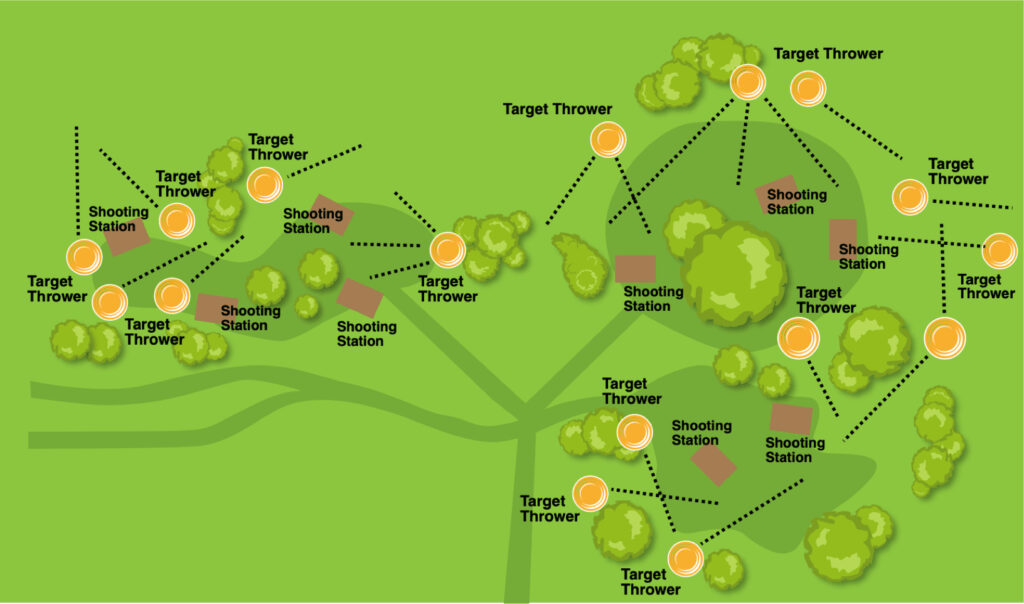
Sporting clays is a challenging form of clay pigeon shooting often described as “golf with a shotgun”. Unlike trap or skeet, which use standardized target paths, sporting clays is designed to simulate the unpredictable flight of game birds and the movement of rabbits in their natural environment.
Key Features of Sporting Clays
- The Course: A typical round consists of 50 to 100 targets spread across 10 to 15 different shooting stations.
- Station Variety: Each station is unique, featuring different terrain and target presentations such as “rising teal,” “decoying ducks,” or “bolting rabbits”.
- Target Types: Courses use six different clay sizes (Standard, Midi, Mini, Battue, Rocket, and Rabbit) to create the illusion of various speeds and distances.
- Shooting Pairs: Targets are often presented in pairs:
- Report Pair: The second target is launched immediately after the first shot is fired.
- True Pair: Both targets are launched at the exact same time.
- Following Pair: The second target is launched automatically a few seconds after the first.
Essential Equipment
- Shotgun: An Over/Under (O/U) is the gold standard because it provides two different Choke Tubes for varying distances. Semi-automatics are also popular for their reduced recoil.
- Ammunition: Standard target loads typically use #7.5, #8, or #9 shot. Most courses strictly prohibit larger shot sizes (like #6 or hunting loads) for safety reasons.
- Safety Gear: Eye and ear protection are mandatory. Many shooters prefer slim electronic earmuffs or molded earplugs to avoid interfering with the gun’s stock when aiming.
- Choke Tubes: Since targets vary from 10 to 50+ yards, carrying a set of interchangeable chokes (Skeet, Improved Cylinder, and Modified) is essential for adjusting your shot pattern.
- Shooting Vest or Pouch: A specialized vest or belt-mounted shell pouch allows you to carry at least 50–100 shells comfortably while keeping your hands free.
- Footwear: Sturdy, closed-toe boots or hiking shoes are recommended, as you will be walking 1–2 miles over uneven, natural terrain.
Quality of Life Additions
- Shooting Glasses with Tinted Lenses: Different colors help clays “pop” against various backgrounds (e.g., amber for clouds or vermillion for green foliage).
- Range Bag or Cart: A dedicated backpack or a push-cart (often a modified jogging stroller) helps transport ammo, water, and tools between stations.
- Brimmed Hat: Helps block sun glare and protects your face from falling clay fragments.
Layout and Setup
Courses are typically laid out over large, varied landscapes like woods or rolling hills to maximize the hunting simulation. Because no two courses are identical, designers have the freedom to position traps anywhere—including on towers, behind trees, or over water.