Trap shooting is a competitive shotgun sport where participants shoot at clay targets launched away from them at varying angles and speeds. A standard game involves a squad of five shooters rotating through five distinct stations.
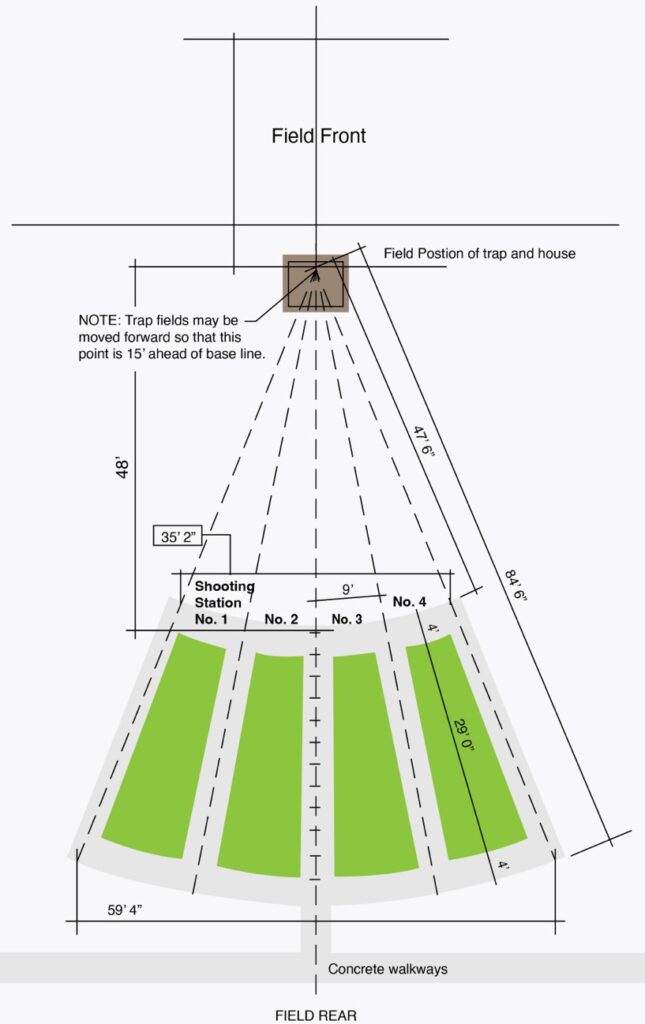
Trap Field Layout
A standard field is designed with precision to ensure consistency across ranges.
- The Trap House: A partially buried structure located 16 yards in front of the primary shooting stations. It houses the trap machine, which oscillates to throw targets at random horizontal angles within an approximate 45-degree arc (22 degrees left or right of the centerline).
- Shooting Stations (Posts): There are five stations arranged in a slight arc.
- Singles & Doubles: Shot from the 16-yard line.
- Handicap: Experienced shooters move further back, up to the 27-yard line.
- Target Flight: Standard targets are set to travel between 49 and 51 yards from the house, reaching a height of 8 to 10 feet at a point 10 yards downrange.
Summary of Trap Disciplines
- Singles: The most common form; shooters fire at one target at a time from the 16-yard line.
- Doubles: Two targets are launched simultaneously from the trap house; also shot from 16 yards.
- Handicap: Similar to singles, but participants stand at a distance (19–27 yards) based on their skill level and past performance.
Key Equipment & Safety
- Shotgun: Typically 12-gauge, often in over-under, semi-automatic, or pump-action configurations.
- Ammunition: Standard shot sizes are #7.5, #8, or #9. Official 2026 ATA rules specify maximum velocities, such as 1290 FPS for 1 1/8 oz loads.
- Safety Gear: Mandatory eye and ear protection.
- Accessories: A shell pouch or vest is used to carry ammunition on the firing line
Field Layout Diagram
Governing Organization